On this page
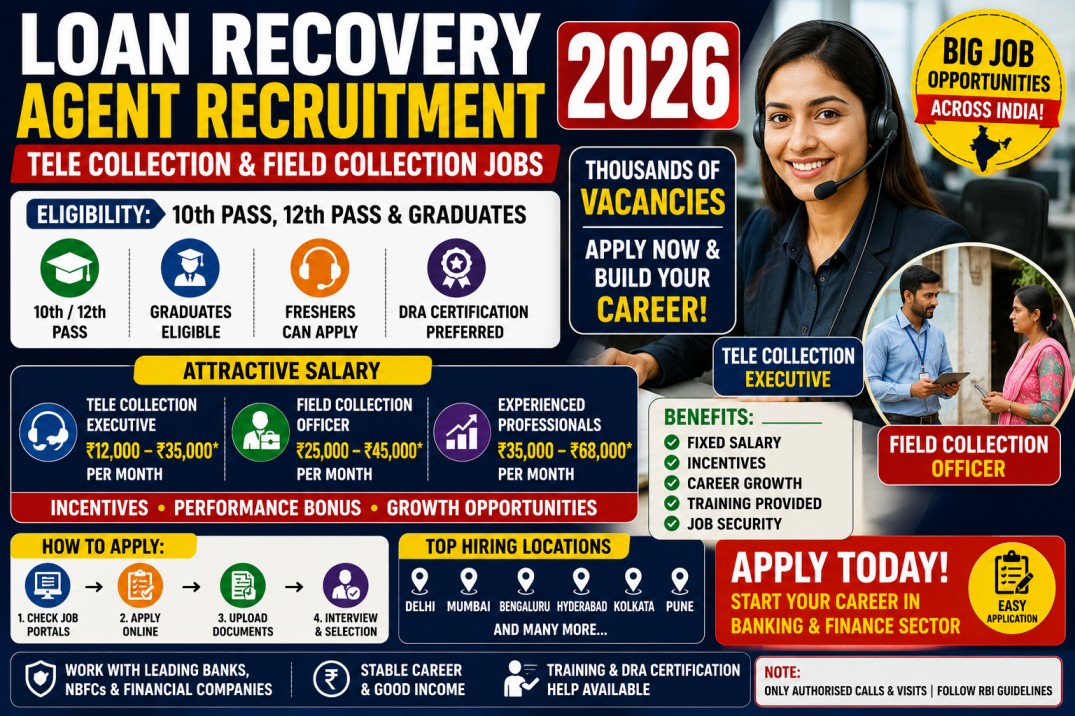
Loan recovery and collection jobs are available across India in banks, Non-Banking Financial Companies, fintech businesses, Business Process Outsourcing companies and authorised collection agencies.
Common job titles include:
- Tele Collection Executive
- Debt Collection Executive
- Field Collection Officer
- Recovery Officer
- Loan Recovery Agent
- Collection Associate
- Collection Team Leader
- Debt Recovery Agent Apprentice
These jobs involve contacting customers with overdue payments, recording repayment commitments and helping lenders manage pending loan or credit-card accounts.
However, there is no single nationwide recruitment called “Loan Recovery Agent Recruitment 2026.” Every bank, NBFC, fintech company and collection agency releases its own vacancies, qualifications and salary terms.
Important: Nuvelloza.com is an independent employment-information website. We do not recruit candidates, collect applications or guarantee jobs.
Loan Recovery Jobs 2026 Overview
| Particular | Details |
|---|---|
| Job sector | Banking, finance, collections and BPO |
| Common positions | Tele Collection Executive and Field Collection Officer |
| Qualification | Depends on employer; Class 10, Class 12 or graduation may be accepted |
| Experience | Fresher and experienced positions may be available |
| Work mode | Office, call centre or field |
| Salary | Depends on employer, city, targets and experience |
| Certification | IIBF DRA certification may be required or preferred |
| Application method | Employer website, job platform or authorised recruiter |
| Official job resource | National Career Service |
Current National Career Service listings include debt-collection telecaller roles for freshers and experienced applicants, but openings change frequently.
What Is a Loan Recovery Agent?
A Loan Recovery Agent is responsible for communicating with borrowers whose loan instalments, credit-card bills or other financial obligations are overdue.
The agent may work directly for a lender or through an authorised external collection agency.
The purpose of the role is to:
- Inform customers about overdue payments
- Explain the outstanding amount and due date
- Record reasons for delayed payment
- Follow up on promised payment dates
- Provide authorised payment options
- Update the lender’s collection system
- Escalate unresolved accounts according to company policy
Recovery staff are not permitted to invent charges, seize property without authority or promise unauthorised settlements.
Main Types of Collection Jobs
1. Tele Collection Executive
Tele Collection Executives usually work from an office or call centre.
Their duties may include:
- Calling customers with overdue accounts
- Confirming customer identity
- Explaining outstanding dues
- Recording payment commitments
- Sending approved payment reminders
- Updating CRM or collection software
- Escalating disputed accounts
- Preparing daily collection reports
- Following lender scripts and compliance rules
Tele collection roles may be available to Class 12 pass candidates, graduates and, in some companies, Class 10 pass candidates.
Communication skills are especially important because the role involves frequent customer interaction.
2. Field Collection Officer
Field Collection Officers visit customer locations after receiving an authorised account allocation.
Their work may include:
- Verifying the customer’s address
- Meeting borrowers
- Delivering authorised notices
- Discussing overdue payments
- Collecting approved documents
- Recording visit outcomes
- Depositing collected payments according to company procedure
- Coordinating with tele-collection and legal teams
Field officers may need:
- A two-wheeler
- Valid driving licence
- Smartphone
- Knowledge of the local area
- Ability to travel
- Strong documentation skills
Cash should be collected only when permitted by the employer and supported by an official receipt and approved process.
3. Recovery Officer
A Recovery Officer may handle a portfolio of overdue accounts and coordinate both telephone and field activity.
Responsibilities may include:
- Reviewing delinquent accounts
- Assigning customer follow-ups
- Monitoring repayment commitments
- Preparing collection reports
- Handling customer disputes
- Coordinating with branch staff
- Escalating difficult cases
- Ensuring compliance with lender policy
Graduation or previous banking, collections or customer-service experience may be preferred.
4. Collection Team Leader
A Team Leader supervises collection executives.
Typical duties include:
- Allocating accounts
- Monitoring calls and visits
- Tracking team targets
- Reviewing customer complaints
- Training employees
- Checking compliance
- Preparing performance reports
- Supporting difficult cases
Employers usually require previous collection experience and team-management skills.
5. Debt Recovery Agent Apprentice
Some organisations advertise apprenticeship opportunities related to debt recovery and collections.
These programmes may provide:
- Basic industry training
- Customer-service experience
- Collection-process exposure
- Compliance awareness
- A monthly stipend
- Work experience for beginners
Apprenticeship India has listed Debt Recovery Agent opportunities, but candidates must check whether a listing is currently open and read its employer-specific conditions.
An apprenticeship does not guarantee permanent employment.
Eligibility Criteria
Eligibility varies between employers.
Common requirements may include:
- Minimum age of 18
- Class 10, Class 12 or graduation
- Basic computer knowledge
- Communication skills
- Ability to work with targets
- Knowledge of local languages
- Smartphone and travel ability for field jobs
- Acceptable background verification
- No serious record of misconduct or fraud
Some employers may prefer candidates with experience in:
- Banking
- Loan collections
- Credit-card collections
- Telecalling
- Customer service
- BPO operations
- Field sales
- Financial services
Can Class 10 Pass Candidates Apply?
Some entry-level collection, telecalling and apprenticeship vacancies may accept Class 10 pass applicants.
However, this is not a universal rule.
Many established banks, NBFCs and collection agencies may prefer:
- Class 12 pass candidates
- Graduates
- Candidates with DRA certification
- Applicants with collection experience
Always follow the qualification stated in the specific job advertisement.
Can Freshers Apply?
Yes, some companies hire freshers for:
- Tele Collection Executive
- Collection Trainee
- Customer Follow-Up Executive
- Debt Recovery Apprentice
- Junior Field Collection Officer
Freshers may receive training in:
- Loan products
- Customer communication
- CRM software
- Payment processes
- Data protection
- Recovery rules
- Complaint handling
Employers may still conduct background, document and communication checks.
DRA Certification
DRA stands for Debt Recovery Agent.
The Indian Institute of Banking and Finance conducts the Certificate Examination for Debt Recovery Agents and DRA telecallers.
IIBF states that DRA certification is required under the applicable RBI framework for people employed as recovery agents, and banks and NBFCs should ensure that their agents complete the required training and certification.
DRA Training Duration
The required training duration depends on educational qualification:
| Candidate category | Training duration |
|---|---|
| Graduate candidates | 50 hours |
| Undergraduate candidates | 100 hours |
IIBF’s accredited-institute listing specifically distinguishes 50-hour graduate batches and 100-hour undergraduate batches.
Therefore, do not state that every candidate must complete a 100-hour course.
How to Obtain DRA Certification
The usual process includes:
- Check the current IIBF eligibility and examination rules.
- Join an IIBF-accredited DRA training institution.
- Complete the applicable 50-hour or 100-hour training programme.
- Register for the IIBF DRA examination.
- Attend the examination.
- Pass according to the applicable rules.
- Receive the certification through the authorised process.
Candidates should use only an institution shown in IIBF’s official accredited-training list.
Is DRA Certification Compulsory Before Applying?
Not every job advertisement requires certification at the application stage.
Some employers may:
- Require an existing DRA certificate
- Prefer certified candidates
- Hire candidates first and arrange training
- Set a deadline for completing certification
The applicant should confirm this directly with the employer.
Never buy a fake DRA certificate or pay an unauthorised person promising guaranteed certification.
Ethical and Legal Responsibilities
Loan recovery is a regulated and sensitive job.
RBI guidance states that banks and their agents must not use intimidation, harassment or inappropriate recovery practices.
Recovery staff must not:
- Threaten borrowers
- Use abusive language
- Humiliate customers
- Contact family members unnecessarily
- Publicly disclose a customer’s debt
- Persistently call at inappropriate hours
- Pretend to be police or court officials
- Use physical force
- Enter a home without permission
- Seize assets without lawful authority
- Demand payment to a personal bank account
- Keep collected cash without issuing an approved receipt
Banks and NBFCs remain responsible for the conduct of the recovery agents acting on their behalf.
Can Agents Offer Loan Settlements?
Recovery staff may explain a settlement, restructuring, foreclosure or payment arrangement only when:
- The lender has authorised it
- The offer is recorded in the system
- Written terms are provided
- The agent is permitted to communicate it
- The customer is informed of the consequences
Agents cannot independently:
- Waive interest
- Remove penalties
- Promise credit-score correction
- Approve a One Time Settlement
- Change EMI terms
- Close a loan account
Final approval belongs to the lender.
Skills Required
Useful skills include:
- Clear communication
- Active listening
- Negotiation
- Patience
- Customer-service ability
- Basic computer knowledge
- CRM software use
- Data-entry accuracy
- Local-language ability
- Time management
- Conflict management
- Report preparation
- Compliance awareness
- Professional behaviour
Field officers may also need:
- Route planning
- Address verification
- Safe travel practices
- Documentation
- Cash-handling knowledge where authorised
Salary of Loan Recovery Agents
There is no fixed national salary.
Pay varies according to:
- Employer
- Job title
- City
- Qualification
- Experience
- Tele or field role
- Monthly targets
- Incentive structure
- Travel requirements
- Portfolio difficulty
A safer general guide is:
| Role | Salary structure |
|---|---|
| Tele Collection Executive | Fixed salary plus possible performance incentives |
| Field Collection Officer | Fixed salary, incentives and possible travel allowance |
| Recovery Officer | Depends on portfolio and experience |
| Team Leader | Higher fixed pay with team-performance incentives |
| Apprentice | Employer-specific stipend |
Do not promise salaries such as ₹68,000 per month to all applicants.
Higher earnings may occur in senior, managerial or high-incentive roles, but they are not guaranteed.
Performance Incentives
Some employers offer incentives based on:
- Successful payment commitments
- Accounts resolved
- Collection amount
- Portfolio performance
- Attendance
- Call quality
- Compliance score
- Team results
Candidates should understand:
- Whether incentives are guaranteed
- How targets are calculated
- When incentives are paid
- Whether cancelled payments affect earnings
- Whether travel expenses are reimbursed
Ask for the salary and incentive terms in writing.
Documents Required
Employers may request:
- Updated resume
- Aadhaar Card
- PAN Card
- Passport-size photograph
- Educational certificates
- Address proof
- Bank details after selection
- Experience certificate
- DRA certificate
- Driving licence for field roles
- Vehicle documents where required
- Police or background verification
- Previous salary proof
- Other employer-specific documents
Do not send an Aadhaar OTP, banking password, ATM PIN or card details to a recruiter.
Selection Process
The hiring process may include:
Application Screening
The employer reviews:
- Qualification
- Location
- Experience
- Communication ability
- DRA certification
- Job preference
Telephone Interview
Applicants may be tested on:
- Communication
- Hindi, English or local-language ability
- Confidence
- Customer handling
- Availability
Face-to-Face or Video Interview
Questions may cover:
- Handling an angry borrower
- Explaining overdue payments
- Recording a payment promise
- Ethical collection practices
- Target-based work
- Field travel
Document Verification
Original or verified copies may be checked.
Background Verification
Financial institutions may conduct:
- Identity verification
- Address verification
- Employment checks
- Criminal-record checks where lawful
- Reference checks
Training
Selected applicants may receive process and compliance training before handling customer accounts.
How to Apply for Collection Jobs
Step 1: Search the Correct Job Title
Use keywords such as:
- Tele Collection Executive
- Loan Recovery Agent
- Field Collection Officer
- Recovery Officer
- Debt Collection Executive
- Collection Associate
- DRA Certified Agent
Step 2: Check Trusted Sources
Candidates may search through:
- National Career Service
- Apprenticeship India
- Official bank career pages
- Official NBFC career pages
- Recognised fintech websites
- Verified private job platforms
Step 3: Verify the Employer
Before applying, check:
- Official company name
- Registered website
- Office address
- Recruiter’s company email
- Job description
- Salary terms
- Whether the company is hiring directly or through an agency
Step 4: Submit a Professional Resume
Include:
- Qualification
- Languages spoken
- Collection experience
- Customer-service experience
- DRA certification
- Computer skills
- Two-wheeler and licence details for field roles
- Preferred location
Do not put sensitive bank information in your resume.
Step 5: Attend the Interview
Prepare examples showing:
- Calm customer handling
- Ethical negotiation
- Accurate record keeping
- Ability to meet targets
- Respect for customer privacy
Job Fraud Warning
Be cautious when a recruiter:
- Guarantees selection
- Demands a security deposit
- Requests a training fee to a personal account
- Conducts the entire process through WhatsApp
- Sends an offer without an interview
- Requests banking passwords or OTPs
- Promises unusually high incentives
- Uses a free email address while claiming to represent a major bank
- Asks you to collect money before issuing an employee ID
- Refuses to provide company details
Do not assume someone works for a bank merely because they use its logo.
Frequently Asked Questions
Can Class 10 pass candidates apply?
Some entry-level and apprenticeship vacancies may accept Class 10 pass candidates. Other employers require Class 12 or graduation.
Can freshers apply?
Yes, selected telecalling, trainee and apprenticeship roles may accept freshers.
Is DRA certification compulsory?
IIBF states that DRA certification is required for people employed as recovery agents under the applicable framework. Some employers may hire candidates and arrange certification within the permitted period.
How long is DRA training?
Graduates generally complete 50 hours, while undergraduate candidates complete 100 hours through an accredited institution.
What is the average salary?
There is no fixed national figure. Salary depends on employer, role, location, experience and incentives.
Is tele collection different from field collection?
Yes. Tele collection is mainly phone- and office-based. Field collection involves authorised customer visits and local travel.
Can an agent threaten a borrower?
No. RBI guidelines prohibit intimidation, harassment and abusive collection conduct.
Can a recovery agent approve a settlement?
Not independently. Any settlement must be authorised by the lender.
Where can I find legitimate openings?
Check National Career Service, Apprenticeship India and official bank, NBFC, fintech or collection-company career pages.
Final Words
Loan recovery and collection work may provide entry-level and experienced employment opportunities in banking and financial services.
Candidates may find roles in:
- Tele collection
- Field collection
- Customer follow-up
- Loan recovery
- Collection operations
- Team supervision
To improve your chances:
- Develop strong communication skills
- Learn basic banking terminology
- Understand ethical collection practices
- Complete DRA training when required
- Apply through verified employers
- Ask for salary terms in writing
- Never pay for guaranteed selection
- Treat borrowers respectfully
Disclaimer
This article is provided for general employment and career information only.
Nuvelloza.com is not a bank, NBFC, collection agency, recruiter, IIBF training institute or job-placement company. We do not accept applications, provide DRA certificates or guarantee employment.
Vacancies, salaries, qualifications, training requirements and incentive plans vary by employer and may change.
Candidates must verify every opportunity through the employer’s official website, National Career Service, Apprenticeship India or another trusted source before applying.

nuvelloza
Nuvelloza’s editorial team is responsible for researching, reviewing, and maintaining this guide.
More articles by this authorRelated guides

What Is the Eligibility for Anganwadi Jobs 2026? Qualification, Age Limit and Local Residency Rules
On this pageAnganwadi Jobs 2026 OverviewBasic Eligibility ConditionsEducational Qualification1. Anganwadi Worker2. Anganwadi Helper or Sahayika3. Mini Anganwadi Worker4. Anganwadi SupervisorAge LimitLocal Residency RequirementCan…
Driver Jobs in India 2026: Eligibility, Salary, Licence Requirements and How to Apply
On this pageDriver Jobs 2026 OverviewWhat Does a Driver Do?Types of Driver Jobs1. Staff Car Driver2. Light Motor Vehicle Driver3. Heavy Motor Vehicle…
RRB ALP Recruitment 2026: 11,127 Assistant Loco Pilot Posts, Eligibility, Exam Pattern and Latest Updates
On this pageRRB ALP Recruitment 2026 OverviewWhat Does an Assistant Loco Pilot Do?RRB ALP Vacancy DetailsEducational QualificationOption 1: Class 10 With ITIOption 2:…