On this page
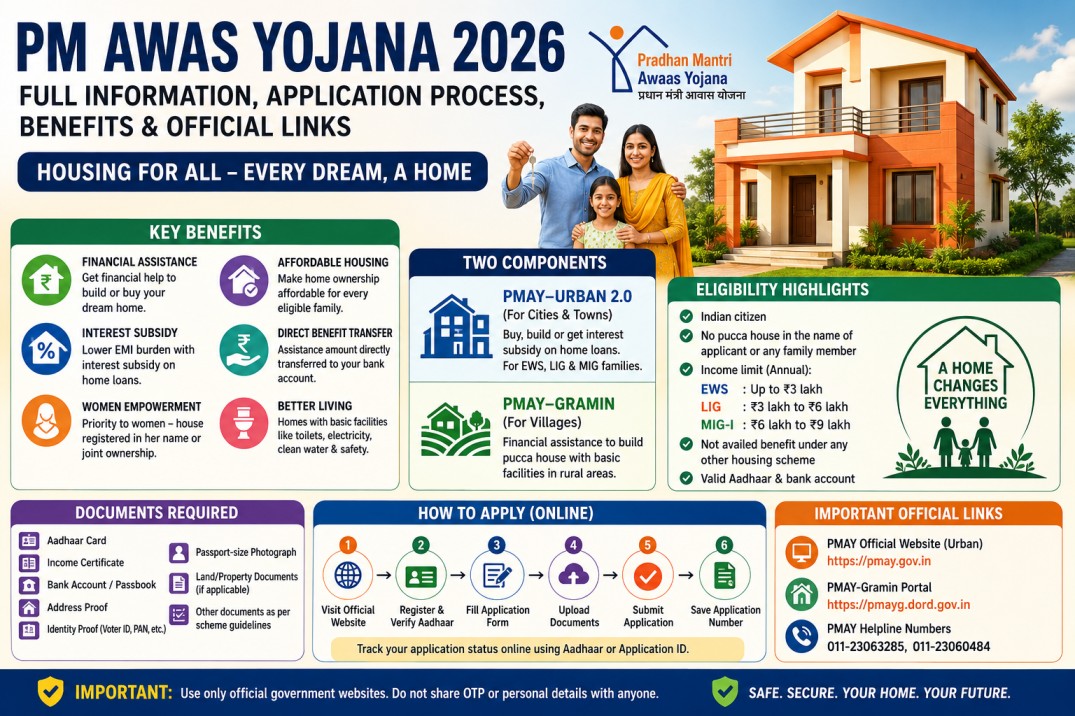
The Pradhan Mantri Awas Yojana, commonly known as PMAY, is a Government of India housing programme created to help eligible families obtain safe and affordable permanent housing.
The scheme has separate components for urban and rural areas:
- Pradhan Mantri Awas Yojana–Urban 2.0, or PMAY-U 2.0
- Pradhan Mantri Awaas Yojana–Gramin, or PMAY-G
Depending on the applicable component, eligible beneficiaries may receive financial assistance for constructing or purchasing a home, an interest subsidy on a qualifying housing loan, or assistance for building a rural house.
This guide explains the current PM Awas Yojana rules, eligibility conditions, benefits, required documents and application process.
Important: Nuvelloza.com is an independent informational website. We are not affiliated with the Ministry of Housing and Urban Affairs, Ministry of Rural Development, PMAY or any government authority. Always verify current details through the applicable official government portal.
PM Awas Yojana 2026 Overview
| Particular | Details |
|---|---|
| Scheme name | Pradhan Mantri Awas Yojana |
| Urban component | PMAY-U 2.0 |
| Rural component | PMAY-G |
| Main objective | Affordable permanent housing for eligible families |
| Urban authority | Ministry of Housing and Urban Affairs |
| Rural authority | Ministry of Rural Development |
| PMAY-U 2.0 period | Five years from September 1, 2024 |
| PMAY-G extension | Financial years 2024–25 to 2028–29 |
| Application method | Depends on urban or rural component |
| Approval | Subject to eligibility and official verification |
What Is PM Awas Yojana?
PM Awas Yojana is a central housing programme that supports eligible households that do not own suitable permanent housing.
PMAY-U was originally introduced in 2015 for urban areas. The Government subsequently approved PMAY-U 2.0 to assist one crore additional urban poor and middle-class families with the construction, purchase or rental of affordable homes over five years.
PMAY-G was launched in April 2016 to provide permanent houses with basic amenities to eligible rural households. The programme has been extended to support the construction of two crore additional rural houses between the financial years 2024–25 and 2028–29.
Types of PM Awas Yojana
1. PM Awas Yojana–Urban 2.0
PMAY-U 2.0 applies to eligible families living in covered urban areas.
The programme provides assistance through four main components:
Beneficiary-Led Construction
Eligible EWS families that own suitable land may receive assistance to construct a new permanent house.
Affordable Housing in Partnership
Eligible EWS beneficiaries may purchase affordable homes built through approved public or private partnership projects.
Affordable Rental Housing
This component supports affordable rental housing for eligible urban residents, including migrants, workers and other low-income groups who may not be able or ready to purchase a home.
Interest Subsidy Scheme
Eligible EWS, LIG and MIG households may receive an interest subsidy on qualifying housing loans sanctioned and disbursed on or after September 1, 2024.
Under PMAY-U 2.0, assistance under Beneficiary-Led Construction and Affordable Housing in Partnership may reach up to ₹2.5 lakh, subject to the applicable central and state contribution, beneficiary category and project rules.
2. PM Awas Yojana–Gramin
PMAY-G is intended for eligible households in rural areas that are houseless or living in kutcha or seriously inadequate houses.
Under PMAY-G, eligible beneficiaries currently receive:
- ₹1.20 lakh for a house in plain areas
- ₹1.30 lakh in specified North-Eastern and hilly regions, including eligible Union Territories
- Support for 90 or 95 person-days of unskilled labour through MGNREGS
- Up to ₹12,000 for toilet construction through eligible converging programmes
These benefits are subject to official selection, verification and programme rules.
Main Benefits of PM Awas Yojana
Financial Assistance for House Construction
Eligible beneficiaries may receive government assistance toward constructing a permanent house.
The exact amount depends on:
- Whether the applicant lives in an urban or rural area
- The selected PMAY component
- Beneficiary income category
- State or Union Territory
- Project type
- Available state contribution
- Official approval
Home-Loan Interest Subsidy
Under the PMAY-U 2.0 Interest Subsidy Scheme, eligible households may receive a subsidy on a qualifying home loan.
The maximum central subsidy under the current urban interest-subsidy component may be up to ₹1.80 lakh, subject to loan, property, income and scheme conditions.
The subsidy is not a general cash reward. It is connected to an eligible housing loan and is released according to scheme rules.
Affordable Housing
PMAY aims to make ownership or access to permanent housing more affordable for eligible lower- and middle-income households.
Preference and Protection for Women
Under applicable PMAY rules, ownership may need to be registered in the name of an adult female household member or jointly with another eligible family member, subject to exemptions and component-specific conditions.
Applicants should check the exact ownership requirement applicable to their application.
Direct Transfer of Approved Assistance
Approved financial assistance may be transferred through verified bank accounts and government payment systems.
Beneficiaries should ensure that their:
- Name
- Aadhaar information
- Bank account
- Mobile number
- Property information
are accurate and consistent.
Housing With Basic Amenities
PMAY-supported homes are intended to provide permanent housing with basic facilities.
Depending on the area and applicable convergence programmes, these may include:
- Toilet facilities
- Electricity
- Drinking water
- Kitchen space
- Sanitation
- Access roads or other local infrastructure
The availability and delivery of each facility may depend on local implementation and linked government programmes.
PMAY-U 2.0 Eligibility Criteria
An urban family may be eligible when it meets the relevant income, property and scheme requirements.
Income Categories
The current PMAY-U 2.0 income categories are:
| Category | Annual household income |
|---|---|
| EWS | Up to ₹3 lakh |
| LIG | More than ₹3 lakh and up to ₹6 lakh |
| MIG | More than ₹6 lakh and up to ₹9 lakh |
Families in these categories must not own a permanent house anywhere in India to qualify under the general PMAY-U 2.0 eligibility conditions.
The older MIG-I and MIG-II limits reaching ₹18 lakh should not be used for a current PMAY-U 2.0 article.
No Permanent House
The applicant and eligible family members generally must not own a pucca house anywhere in India.
A pucca house is a permanent house built with durable materials, subject to the definition applied under the scheme.
No Duplicate Central Housing Benefit
A family that has already received a house under a central government housing scheme during the restricted period may not qualify for another PMAY-U 2.0 benefit.
Applicants must disclose previous housing assistance honestly.
Eligible Location
The property or proposed house must be located within an area covered by PMAY-U 2.0.
Covered areas include eligible statutory towns and other officially notified planning or development areas.
Component-Specific Conditions
Not every income group can use every PMAY-U 2.0 component.
For example:
- Beneficiary-Led Construction is primarily for qualifying EWS households
- Affordable Housing in Partnership primarily supports EWS beneficiaries
- Interest Subsidy may cover eligible EWS, LIG and MIG households
- Affordable Rental Housing has separate occupancy and income rules
Applicants should choose the correct component carefully because the official portal states that the selected component cannot later be changed through the same application.
PMAY-G Eligibility Criteria
PMAY-G selection is not based only on income-category declarations.
Eligible rural beneficiaries are generally identified using:
- Housing-deprivation information
- Official survey data
- Awaas+ records
- Applicable exclusion criteria
- Verification by the Gram Sabha
- State and local authority approval
The programme is intended primarily for eligible houseless rural households and families living in kutcha or dilapidated houses.
Merely submitting documents or having a low income does not guarantee inclusion in the final beneficiary list.
Who May Not Qualify?
A household may be excluded depending on current PMAY-G criteria, assets and official verification.
Potential exclusion factors may include ownership of certain assets, a permanent house, government employment, income-tax status or other conditions listed in the current survey and programme rules.
Applicants should use the official PMAY-G eligibility checker or contact their Gram Panchayat for an accurate assessment.
Documents Required for PM Awas Yojana
The exact documents vary according to the component, location and applicant profile.
Commonly requested documents may include:
- Aadhaar Card
- Aadhaar-linked mobile number
- Bank passbook or bank-account details
- Passport-size photograph
- Address proof
- Income certificate
- Self-declaration of household income
- Voter ID
- PAN Card, where required
- Ration Card
- Family details
- Proof that the family does not own a permanent house
- Land or property documents
- Housing-loan documents
- Caste or category certificate, where applicable
- Disability certificate, where applicable
All names and personal details should match across the documents.
How to Apply for PMAY-U 2.0 Online
Eligible urban applicants can use the official PMAY-U 2.0 application portal.
Step 1: Check Eligibility
Open the official PMAY-U 2.0 portal and select the eligibility-check or application option.
Read the conditions for all four components before proceeding.
Step 2: Select the Correct Component
Select the component that matches your situation:
- Beneficiary-Led Construction
- Affordable Housing in Partnership
- Affordable Rental Housing
- Interest Subsidy Scheme
Do not select a component only because it appears to provide a higher benefit.
Step 3: Verify Aadhaar
Enter the requested Aadhaar information and complete the supported identity-verification process.
Never share your Aadhaar OTP with an agent or unknown person.
Step 4: Enter Household Details
Provide accurate information about:
- Applicant
- Family members
- Annual household income
- Existing house ownership
- Present address
- Proposed property or land
- Bank account
- Previous government housing benefits
Step 5: Upload or Provide Documents
Submit the documents requested by the portal or local implementing authority.
Some documentation may need to be provided later during physical or administrative verification.
Step 6: Review and Submit
Review every entry carefully before submitting the form.
Saving or submitting an application does not guarantee approval. Eligibility must still be verified by the appropriate state, urban local body, bank, financial institution or implementing authority.
Step 7: Save the Application Number
Download or note the acknowledgement and application number.
Keep it safe for status tracking and future communication.
How to Apply for PMAY-U 2.0 Offline
Urban applicants who need assistance may contact:
- Municipal Corporation
- Municipality
- Nagar Panchayat
- Urban Local Body
- Common Service Centre
- Approved housing agency
- Participating bank or housing finance company for interest subsidy
Carry original documents and photocopies.
Confirm that the centre is authorised before paying any fee or sharing personal information.
How to Apply for PMAY-G
The PMAY-G process is different from the urban process.
Rural households are generally identified through official beneficiary surveys and verified lists rather than receiving approval through a simple public application form.
Step 1: Contact the Gram Panchayat
Visit your:
- Gram Panchayat
- Block Development Office
- Rural housing office
- Designated PMAY-G assistance centre
Ask whether your household appears in the relevant PMAY-G or Awaas+ list.
Step 2: Confirm Survey Details
Check whether your family’s:
- Name
- Address
- Housing condition
- Aadhaar details
- Bank information
- Family information
have been recorded correctly.
Step 3: Complete Verification
The household may undergo:
- Gram Sabha verification
- Document verification
- Physical verification of the existing house
- Eligibility and exclusion checks
- Bank-account validation
Step 4: Check the Beneficiary List
After approval, the household’s details may appear in the official sanctioned beneficiary records.
Being surveyed does not automatically mean that the household has been approved.
Step 5: Follow Construction Requirements
Approved beneficiaries must follow the construction, geo-tagging and instalment conditions communicated by the responsible authority.
How PMAY-G Financial Assistance Is Released
PMAY-G assistance is generally transferred in instalments linked to the progress of house construction.
The number and timing of instalments can differ between states.
Construction progress may be verified through:
- Geo-tagged photographs
- Physical inspection
- Official mobile applications
- Local-authority confirmation
- Stage-of-construction records
Do not describe a universal four-instalment process unless the applicable state’s official guidelines confirm it.
How to Check PMAY Application Status
PMAY-U 2.0 Status
Urban applicants may check their application through the official PMAY-U portal using the available identifiers.
These may include:
- Application number
- Aadhaar details
- Registered mobile number
- Assessment ID
PMAY-G Status
Rural applicants may check through:
- The official PMAY-G portal
- Gram Panchayat
- Block Development Office
- Local rural housing authority
- Official beneficiary or sanction lists
Do not rely solely on third-party websites claiming to show guaranteed beneficiary status.
Official PMAY Resources
Applicants should use only genuine government resources:
- PMAY-U 2.0 official portal: Application, eligibility and urban-scheme information
- PMAY-G official portal: Rural housing information and beneficiary services
- Ministry of Housing and Urban Affairs: Official urban housing information
- Ministry of Rural Development: Official rural-development information
PMAY Helpline and Contact Information
The official PMAY-U website currently lists these contact numbers:
- 011-23063285
- 011-23060484
- 011-23063620
- 011-23063567
- 011-23061827
Contact information can change, so confirm it through the official PMAY-U contact page before calling.
For PMAY-G concerns, contact the Gram Panchayat, Block Development Office or the rural housing authority in your state.
Common Reasons for Rejection or Delay
An application may be rejected, returned or delayed because of:
- Applicant already owns a permanent house
- Household income exceeds the applicable limit
- Aadhaar details do not match
- Incorrect bank-account information
- Duplicate application
- Previous housing assistance was not disclosed
- Applicant selected the wrong PMAY component
- Property is outside an eligible area
- Required land ownership is unavailable
- Incomplete documents
- Applicant is not present in the verified rural beneficiary list
- Applicant meets a PMAY-G exclusion condition
- Physical-verification details do not match the application
Applicants should correct information only through authorised channels.
Fraud-Prevention Tips
- Use only official government portals.
- Do not pay an agent for guaranteed selection.
- Never share an Aadhaar OTP or bank password.
- Do not transfer money to a personal account for application approval.
- Verify the website domain before entering information.
- Keep the acknowledgement and payment receipt.
- Do not submit multiple applications using different information.
- Report suspicious agents to the appropriate authority.
No person can guarantee PMAY approval without official eligibility verification.
Frequently Asked Questions
Can anyone apply for PM Awas Yojana?
People may check their eligibility, but assistance is available only to households that meet the applicable PMAY-U or PMAY-G requirements.
What is the PMAY-U 2.0 income limit?
The current categories are:
- EWS: up to ₹3 lakh
- LIG: above ₹3 lakh and up to ₹6 lakh
- MIG: above ₹6 lakh and up to ₹9 lakh
Is the PMAY benefit paid completely in cash?
No. The form of assistance depends on the component. It may be construction assistance, a contribution toward an approved affordable house or an interest subsidy connected with a qualifying housing loan.
How much assistance is available under PMAY-G?
The current unit assistance is ₹1.20 lakh in plain areas and ₹1.30 lakh in specified North-Eastern and hilly regions. Additional support may be available for labour and toilet construction through linked programmes.
Can I apply for PMAY-G directly online?
Rural selection normally depends on official surveys, beneficiary lists, Gram Sabha verification and local-authority approval. Contact the Gram Panchayat if your eligible household is missing or its details are incorrect.
Does completing the PMAY-U form guarantee a house?
No. Submitting an application does not guarantee approval. The information must be verified by the responsible authorities.
Can I apply if my parents own a house?
Eligibility depends on how the scheme defines the applicant’s beneficiary family and household. Declare all relevant family and ownership information honestly and obtain clarification from the responsible authority.
Can I apply through an agent?
Use an authorised government centre if assistance is required. Avoid private agents who promise guaranteed approval.
Final Words
PM Awas Yojana may help eligible urban and rural families obtain safe permanent housing, but the two components have different eligibility and application procedures.
Before applying:
- Identify whether PMAY-U 2.0 or PMAY-G applies
- Check the latest eligibility rules
- Confirm your household-income category
- Verify house and property ownership
- Prepare matching documents
- Use only official portals or authorised offices
- Keep your application acknowledgement
- Do not trust guaranteed-approval claims
Government guidelines, assistance amounts, application facilities and eligibility conditions may change. Always confirm current information through the relevant official authority.
Disclaimer
This article is provided only for general informational purposes.
Nuvelloza.com does not issue houses, process applications, select beneficiaries, provide loans or guarantee government assistance.
Final eligibility and approval are determined by the relevant ministry, state or Union Territory, Urban Local Body, Gram Sabha, financial institution or other authorised government agency.
Readers should verify all information through the applicable official PMAY portal before submitting documents, purchasing property or taking a housing loan.

nuvelloza
Nuvelloza’s editorial team is responsible for researching, reviewing, and maintaining this guide.
More articles by this authorRelated guides
Free Silai Machine Yojana 2026: Real Schemes, Eligibility and How to Apply
On this pageFree Silai Machine Scheme 2026 OverviewIs Free Silai Machine Yojana Real?PM Vishwakarma Support for TailorsWho May Qualify Under PM Vishwakarma?State-Level Sewing-Machine…
Pradhan Mantri Mudra Yojana 2026: Eligibility, Benefits and Application Process for Loans Up to ₹20 Lakh
On this pagePradhan Mantri Mudra Yojana 2026 OverviewWhat Is Pradhan Mantri Mudra Yojana?Why Was Mudra Yojana Started?Mudra Loan Categories1. Shishu Loan2. Kishor Loan3.…
Labour Card 2026: How to Apply Online, Eligibility, Benefits and Required Documents
On this pageLabour Card 2026: How to Apply Online, Eligibility, Benefits and Required DocumentsLabour Card 2026 OverviewWhat Is a Labour Card?Is a Labour…