On this page
Labour Card 2026: How to Apply Online, Eligibility, Benefits and Required Documents
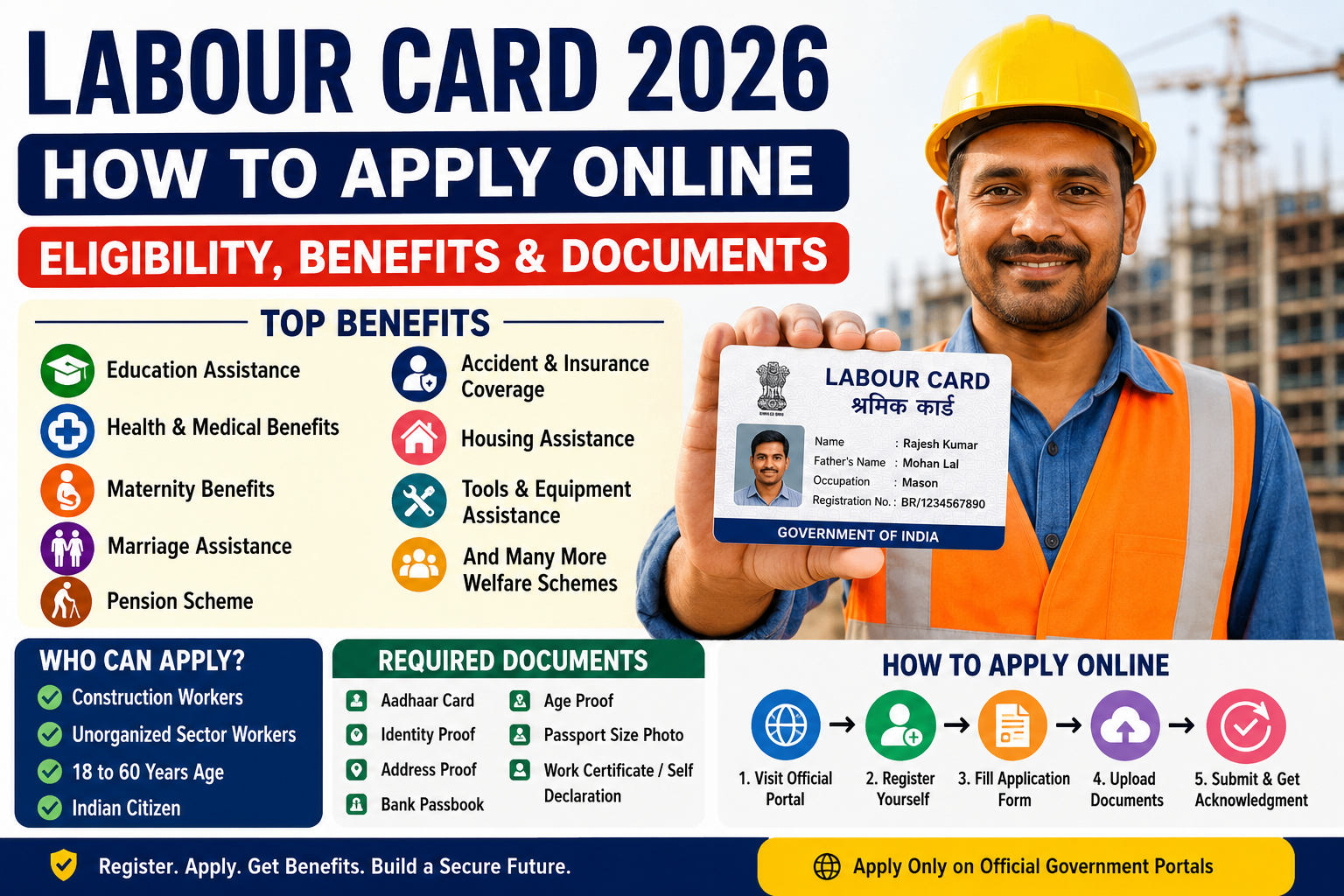
A Labour Card is a general term commonly used for worker-registration cards issued through state Labour Departments, Labour Welfare Boards, or Building and Other Construction Workers Welfare Boards.
These registrations are intended to connect eligible workers with welfare schemes such as medical assistance, education support, maternity benefits, pensions, accident assistance, housing support, and other social-security programmes.
However, there is no single Labour Card with identical benefits throughout India. Eligibility, registration requirements, fees, renewal rules, and financial benefits vary between states and schemes.
Workers should apply only through their state’s official Labour Department, BOCW Welfare Board, e-Shram portal, Common Service Centre, or another authorised government channel.
Important: Nuvelloza.com is an independent informational website. We do not issue Labour Cards, approve applications, or collect registration fees. Always verify current information through the appropriate official government portal.
Labour Card 2026 Overview
| Particular | Details |
|---|---|
| Card or registration type | Labour Card, BOCW Card or worker-registration card |
| Responsible authority | State Labour Department or Welfare Board |
| Main beneficiaries | Eligible workers in construction and other covered sectors |
| Application mode | Online or through an authorised service centre |
| Benefits | Vary according to state and scheme |
| Registration fee | Depends on the applicable state rules |
| Renewal | May be required periodically |
| e-Shram registration | Separate national registration for unorganised workers |
| Official ministry | Ministry of Labour and Employment |
What Is a Labour Card?
A Labour Card generally identifies a worker who has registered with an applicable state Labour Department or Welfare Board.
For construction workers, registration is often managed by a state Building and Other Construction Workers Welfare Board, commonly called a BOCW Welfare Board.
State BOCW Welfare Boards administer welfare support for eligible construction workers. Depending on state rules, support may include medical assistance, education for workers’ children, and financial assistance following an accident or death.
A worker must meet the applicable eligibility requirements and complete registration before claiming benefits.
Is a Labour Card the Same as an e-Shram Card?
Not necessarily.
Labour or BOCW Card
A Labour or BOCW Card is generally issued under a state-level Labour Department or Welfare Board.
It may provide access to specific welfare benefits offered by that state board.
e-Shram Card
The e-Shram portal is a national platform operated by the Ministry of Labour and Employment for registering workers in the unorganised sector and issuing a Universal Account Number.
Registration on e-Shram is an entry point that may help workers access or discover social-security programmes. It does not automatically guarantee every listed welfare benefit or cash payment.
Some construction workers may need both:
- e-Shram registration; and
- Registration with their state BOCW Welfare Board.
Workers should check the requirements applicable in their state and occupation.
Main Purpose of a Labour Card
The purpose of worker registration is to help eligible workers access welfare programmes that may include:
- Financial assistance
- Medical support
- Accident or disability assistance
- Education assistance for children
- Maternity benefits
- Pension programmes
- Housing assistance
- Work-tool assistance
- Skill-development programmes
- Other state welfare benefits
Receiving a card does not mean every benefit is automatically credited. Workers normally have to meet the conditions of each individual scheme and submit a separate benefit claim where required.
Benefits of a Labour Card
The benefits available depend on the state, Welfare Board, occupation, contribution status, age, and scheme conditions.
Common types of support may include the following.
1. Education Assistance
Eligible registered workers may be able to apply for educational support for their children.
Depending on the state scheme, this may include:
- School scholarships
- Assistance with education expenses
- Support for college or professional courses
- Merit-based assistance
- Assistance for books, uniforms, or learning materials
- Bicycle or transport support under selected schemes
The amount and eligibility rules may depend on the child’s class, course, examination results, and the worker’s registration status.
2. Health and Medical Assistance
Some Labour Welfare Boards provide medical assistance to eligible workers or their dependants.
Support may include:
- Assistance for hospital treatment
- Financial help for specified illnesses
- Maternity-related medical support
- Reimbursement under approved conditions
- Health-check programmes
- Access to linked health-insurance schemes
Not every medical expense is covered. Applicants should check the approved treatment, hospital, documentation, and claim limits before relying on the benefit.
3. Maternity Benefits
Eligible registered women workers may receive maternity assistance under certain state schemes.
In some cases, support may also be available to the spouse of a registered male worker.
Eligibility may depend on:
- Active registration
- Minimum contribution period
- Number of children
- Medical or birth documents
- Application deadline
- State-specific conditions
4. Marriage Assistance
Some state Welfare Boards offer marriage assistance for:
- The marriage of an eligible registered woman worker
- The marriage of a registered worker’s daughter
- Other categories specified by the applicable scheme
The worker may need to complete a minimum registration period and submit proof of age, relationship, marriage, and registration status.
5. Pension Support
Eligible workers may be able to access old-age pension or contributory pension schemes.
Some pension schemes require the worker to make regular contributions. For example, the Pradhan Mantri Shram Yogi Maan-Dhan scheme is a voluntary and contributory pension programme in which the eligible beneficiary and Central Government provide matching contributions.
A Labour Card or e-Shram registration alone does not necessarily provide an automatic monthly pension.
6. Accident, Disability and Death Assistance
Some Welfare Boards provide assistance when an eligible registered worker experiences:
- Accidental injury
- Temporary or permanent disability
- Accidental death
- Natural death
- Funeral expenses
The worker or nominee may need to provide:
- Medical records
- Disability certificate
- Death certificate
- Police report where applicable
- Nominee details
- Bank information
- Proof of active registration
The amount varies substantially between states and benefit schemes.
7. Housing Assistance
Certain state Welfare Boards may offer assistance for:
- Construction of a house
- Repair of an existing home
- Purchase of housing
- Access to another government housing scheme
Housing support is not available under every Labour Card programme, and additional income, property, land, or residency conditions may apply.
8. Tool, Equipment or Bicycle Assistance
Eligible workers in certain trades may receive assistance for purchasing:
- Work tools
- Safety equipment
- Bicycles
- Toolkits
- Protective clothing
- Trade-specific equipment
The worker may need to belong to an approved occupation and provide receipts or other supporting documents.
9. Skill Development
Registered workers may be offered:
- Skill training
- Safety training
- Certification
- Recognition of prior learning
- Employment assistance
- Trade-upgradation programmes
Availability depends on state programmes and participating training centres.
Labour Card Benefit Amounts
There is no single national benefit-amount chart that applies to every Labour Card holder.
Benefit amounts depend on:
- State or Union Territory
- Applicable Welfare Board
- Type of benefit
- Worker’s occupation
- Duration of registration
- Contribution status
- Age
- Family circumstances
- Documents submitted
- Current scheme rules
- Available board funds
For example, education, maternity, marriage, pension, accident, death, disability, housing, and medical-assistance amounts may differ widely from one state to another.
Do not publish or rely on a single fixed amount without checking the latest notification from the relevant state Welfare Board.
Who Can Apply for a Labour Card?
Eligibility depends on the type of registration.
For a state BOCW Card, the applicant generally needs to be an eligible building or construction worker and meet the state board’s conditions.
Potentially covered workers may include:
- Masons
- Construction helpers
- Carpenters
- Electricians working on construction sites
- Plumbers
- Painters
- Welders
- Tile workers
- Road-construction workers
- Building workers
- Concrete workers
- Demolition workers
- Other notified construction occupations
Other unorganised workers may be eligible for e-Shram registration or a different state labour-welfare programme.
These workers may include:
- Domestic workers
- Street vendors
- Agricultural workers
- Migrant workers
- Drivers
- Delivery workers
- Platform or gig workers
- Self-employed workers
- Daily-wage workers
- Other eligible unorganised-sector workers
General Eligibility Conditions
Depending on the scheme, applicants may need to:
- Be an Indian citizen or eligible resident
- Reside or work in the applicable state
- Fall within the permitted age range
- Work in an approved occupation
- Have completed the minimum required number of workdays
- Not be covered under a disqualifying category
- Provide evidence of employment
- Pay the applicable registration or contribution fee
- Maintain active registration
The often-mentioned age range of 18 to 60 years is not universal. Applicants must check the exact age conditions on their state’s official portal.
Documents Required for a Labour Card
The documents required vary by state and registration type.
Commonly requested documents may include:
- Aadhaar Card
- Recent passport-size photograph
- Mobile number
- Address proof
- Age proof
- Bank passbook or cancelled cheque
- Ration Card
- Residence certificate
- Work certificate
- Employer or contractor certificate
- Self-declaration of occupation
- Proof of required construction workdays
- Nominee details
- Family details
- Income certificate, where required
- Existing registration details for renewal
For e-Shram registration, the official portal states that an Aadhaar number, an Aadhaar-linked mobile number, and savings-bank account information are required.
Applicants whose mobile number is not linked to Aadhaar may need assistance through an authorised Common Service Centre or another supported verification method.
How to Apply for a Labour Card Online
Because every state uses a different portal, the exact steps may vary.
The general online process is as follows.
Step 1: Identify the Correct Registration
First, determine whether you need:
- A state BOCW Card
- Another state Labour Welfare Board registration
- An e-Shram Card
- A scheme-specific registration
Do not assume these registrations are interchangeable.
Step 2: Visit the Official Government Portal
Open the official website of your state Labour Department or BOCW Welfare Board.
Check that the website belongs to a government domain or is linked from an official government page.
Avoid websites that promise guaranteed approval or request unnecessary payments.
Step 3: Create an Account
Select the worker-registration option.
Enter the requested details, which may include:
- Mobile number
- Aadhaar number
- Name
- Date of birth
- State
- District
Complete OTP or other identity verification.
Step 4: Fill Out the Application
Enter accurate information about:
- Personal details
- Address
- Occupation
- Employer or contractor
- Work experience
- Construction-work period
- Family members
- Bank account
- Nominee
The spelling of the applicant’s name should match the supporting documents.
Step 5: Upload Documents
Upload clear and readable copies of the required documents.
Follow the specified:
- File format
- File-size limit
- Photograph dimensions
- Signature requirements
Blurred, incomplete, or expired documents may delay or prevent approval.
Step 6: Pay the Applicable Fee
Some state boards may charge a registration fee, contribution, or renewal amount.
Pay only through the official payment system and keep the receipt.
Do not make payments to an unknown agent’s personal bank account or wallet.
Step 7: Submit the Application
Review all details before submitting.
Check particularly:
- Aadhaar number
- Name
- Date of birth
- Bank details
- Occupation
- Mobile number
- Uploaded documents
After submitting, note the application or acknowledgement number.
Step 8: Track the Application
Use the application number, mobile number, or login account to check the status.
Possible statuses may include:
- Submitted
- Under verification
- Pending for documents
- Approved
- Rejected
- Card generated
Step 9: Download the Labour Card
After approval, log in to the official portal and look for options such as:
- Download Card
- Print Registration Certificate
- Worker ID
- Beneficiary Card
Save a digital copy and print it if needed.
How to Register on e-Shram
Unorganised workers can use the official e-Shram portal for self-registration or visit an authorised Common Service Centre.
The e-Shram help service provides options for self-registration, updating an existing profile, and locating a nearby CSC.
The general process includes:
- Visit the official e-Shram portal.
- Select the registration option.
- Enter the Aadhaar-linked mobile number.
- Complete OTP verification.
- Provide personal and occupational information.
- Add bank-account details.
- Review and submit the information.
- Download the e-Shram Card containing the UAN.
Registration does not automatically approve the worker for all government schemes. Separate eligibility and applications may still be required.
How to Apply Offline
Workers who cannot apply online may visit:
- An authorised Common Service Centre
- The district Labour Office
- A state BOCW Welfare Board office
- An officially notified facilitation centre
- An authorised registration camp
Carry original documents along with photocopies.
Before submitting information, confirm that the office or operator is authorised.
Labour Card Renewal Process
Some state Labour Cards must be renewed periodically.
The renewal process may require the worker to:
- Log in to the official portal.
- Select the renewal option.
- Confirm or update personal details.
- Provide updated work evidence.
- Upload any newly required documents.
- Pay the renewal fee or contribution.
- Submit the request.
- Save the acknowledgement receipt.
Failing to renew on time may cause registration to become inactive and may affect eligibility for benefits.
Renewal rules and grace periods vary by state.
How to Check Labour Card Status
Applicants may generally check their status by:
- Opening the official state portal.
- Selecting “Application Status” or a similar option.
- Entering the application number or registered mobile number.
- Completing OTP or captcha verification.
- Reviewing the displayed status.
Contact the relevant Labour Office if the application remains pending for an unusually long period.
Common Reasons for Labour Card Rejection
Applications may be rejected or returned because of:
- Incorrect Aadhaar details
- Name or date-of-birth mismatch
- Incomplete application
- Unclear document uploads
- Invalid work certificate
- Insufficient proof of construction work
- Incorrect occupation
- Duplicate registration
- Invalid bank information
- Applicant outside the permitted age range
- Applicant not meeting the scheme’s work requirements
- Expired or inactive previous registration
- Failure to pay the required fee
- Application submitted on the wrong portal
If rejected, read the official reason carefully before submitting a correction or fresh application.
Important Safety Tips
- Apply only through official government portals.
- Never share an OTP with an unknown person.
- Do not share your ATM PIN or internet-banking password.
- Avoid agents promising guaranteed approval.
- Verify the portal address before entering Aadhaar information.
- Keep copies of applications and payment receipts.
- Use a bank account in the applicant’s name where required.
- Keep your registered mobile number active.
- Update occupation and bank information when necessary.
- Verify benefit details through the relevant state board.
Frequently Asked Questions
Is a Labour Card available throughout India?
Worker-registration programmes are available across India, but the card name, rules, and benefits vary by state and category.
Is the Labour Card the same in every state?
No. Each state Labour Department or Welfare Board may have different eligibility rules, benefits, fees, and application procedures.
Can agricultural workers apply for a BOCW Card?
A BOCW Card is generally intended for eligible building and construction workers. Agricultural workers may instead qualify for e-Shram registration or other schemes, depending on applicable rules.
Does every Labour Card holder receive monthly money?
No. Registration does not guarantee a monthly payment. A worker must qualify separately for each benefit or scheme.
Can I receive a pension with a Labour Card?
Some eligible workers may access a pension programme, but it may require a separate application, regular contributions, minimum age, and other conditions.
Is e-Shram registration free?
Self-registration through the official e-Shram platform is provided through government channels. Applicants should avoid paying unauthorised agents.
Can I apply without an Aadhaar-linked mobile number?
Online self-registration may require Aadhaar-linked mobile verification. Workers may visit an authorised CSC to check available assisted-registration options.
How long does approval take?
Processing time varies depending on the state, verification requirements, workload, and whether additional documents are needed.
Where can I download my Labour Card?
After approval, download it from the same official state portal where the application was submitted.
Final Words
A Labour Card can help eligible workers access welfare programmes administered by state Labour Departments and Welfare Boards.
Before applying, confirm:
- Which registration applies to your occupation
- Whether you need a BOCW Card or e-Shram Card
- Your state’s eligibility rules
- Required work evidence
- Registration and renewal fees
- Available benefits
- Official application portal
Do not rely on social-media messages or unofficial websites that promise fixed cash benefits.
Scheme rules and financial assistance may change, so always verify the latest information through your state Labour Department, BOCW Welfare Board, e-Shram portal, or Ministry of Labour and Employment.
Disclaimer
This article is provided for general informational purposes only.
Nuvelloza.com is not affiliated with the Ministry of Labour and Employment, e-Shram, any state Labour Department, BOCW Welfare Board, Common Service Centre, or other government authority.
Eligibility, benefit amounts, required documents, application procedures, and renewal rules vary by state and may change. Always confirm current information through the applicable official government portal before applying.

nuvelloza
Nuvelloza’s editorial team is responsible for researching, reviewing, and maintaining this guide.
More articles by this authorRelated guides
Free Silai Machine Yojana 2026: Real Schemes, Eligibility and How to Apply
On this pageFree Silai Machine Scheme 2026 OverviewIs Free Silai Machine Yojana Real?PM Vishwakarma Support for TailorsWho May Qualify Under PM Vishwakarma?State-Level Sewing-Machine…
Pradhan Mantri Mudra Yojana 2026: Eligibility, Benefits and Application Process for Loans Up to ₹20 Lakh
On this pagePradhan Mantri Mudra Yojana 2026 OverviewWhat Is Pradhan Mantri Mudra Yojana?Why Was Mudra Yojana Started?Mudra Loan Categories1. Shishu Loan2. Kishor Loan3.…
PM Awas Yojana 2026: Eligibility, Benefits, Application Process and Official Links
On this pagePM Awas Yojana 2026 OverviewWhat Is PM Awas Yojana?Types of PM Awas Yojana1. PM Awas Yojana–Urban 2.0Beneficiary-Led ConstructionAffordable Housing in PartnershipAffordable…